What Happens During Early Labor? What to Expect Before Active Labor Begins
Many people imagine labor beginning dramatically, because that's what they see in the movies! Their water breaks, contractions are immediately intense, and it’s time to rush to the hospital.
For most families, that’s not what happens.
Early labor is often slow, unpredictable, and surprisingly underwhelming. It may last most of the day or, especially for first-time parents, even longer. Understanding what’s normal during this stage can help you feel more confident, more comfortable, and less likely to wonder if you’re “doing labor wrong.”

What Is Early Labor?
Early labor is your body beginning to make the physical changes necessary for birth. During this time, your uterus begins contracting in a pattern that will gradually become longer, stronger, and closer together. That progression eventually leads into active labor.
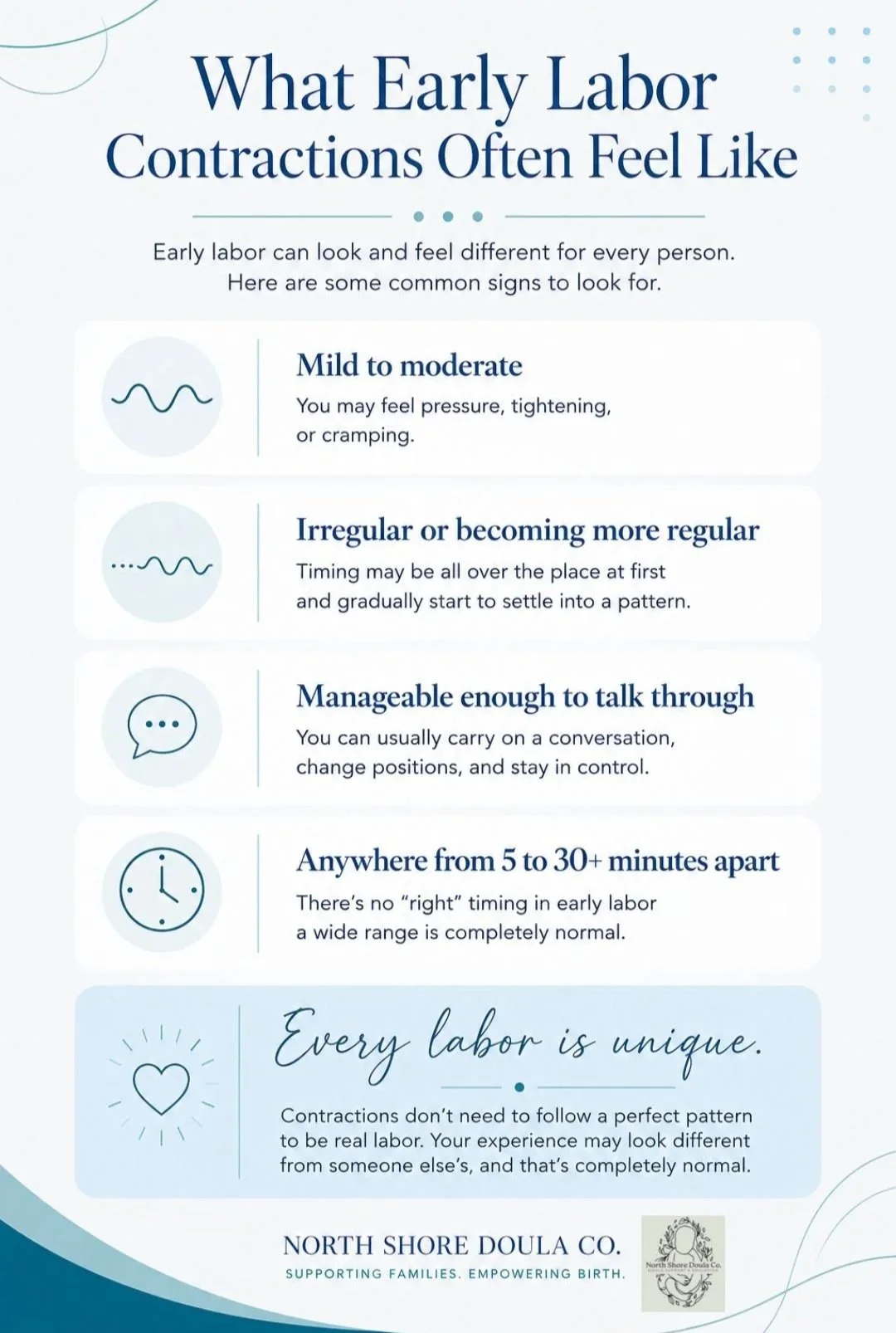
Your contractions in early labor might feel like period cramps. Sometimes they can be felt low in the pelvis, near the pubic bone. Occasionally they can be felt in the lower back. This is the beginning of cervical change! Every contraction is doing part of the work. Together, they help your cervix soften, thin (efface), and gradually dilate.
Common Signs of Early Labor
One of the reasons early labor can be confusing is because it doesn’t always follow a textbook outline. Not everyone experiences every sign and symptom of early labor.
Some signs of early labor include:
Mild, rhythmic contractions
Backache
Menstrual-like cramping
Bloody show
Losing the mucus plug
Water breaking (though this is not how labor starts for most people)
Loose stools
Feeling unusually emotional or excited
Nesting energy… or the urge to sleep
You can have one or some of these symptoms. Everyone’s experience of early labor can look a little different. Some people notice many of these changes. Others notice only one or two.
What Should You Do During Early Labor?
Rest if you can!
Rest during early labor is essential. Labor can be a very long experience, and pacing yourself is key. Resting, fueling your body, and hydration are the most important things you can do during early labor.
If labor begins overnight, sleep between contractions if possible! If sleeping between contractions becomes challenging, try meditation, an audiobook, or binge-watching your favorite cozy show. A warm shower or bath is also a nice way to relax during early labor.
If it begins during the day, don't feel pressure to make labor happen faster. Prioritize relaxation and cozy vibes. Easy movement like a walk or light stretching is a good option, but make sure not to overdo it. When you shift into active labor, you will start actively using movement to cope with the increasing intensity of contractions.
Your body is already doing important work! Honor that by giving it everything you need; rest, water, food.

Eat and drink
Labor is physical work! And even in early labor, when contractions are far apart or their rhythm is sporadic, you will be expending a lot of energy.
Staying well nourished is important to ensure that you can sustain your energy levels as labor progresses.
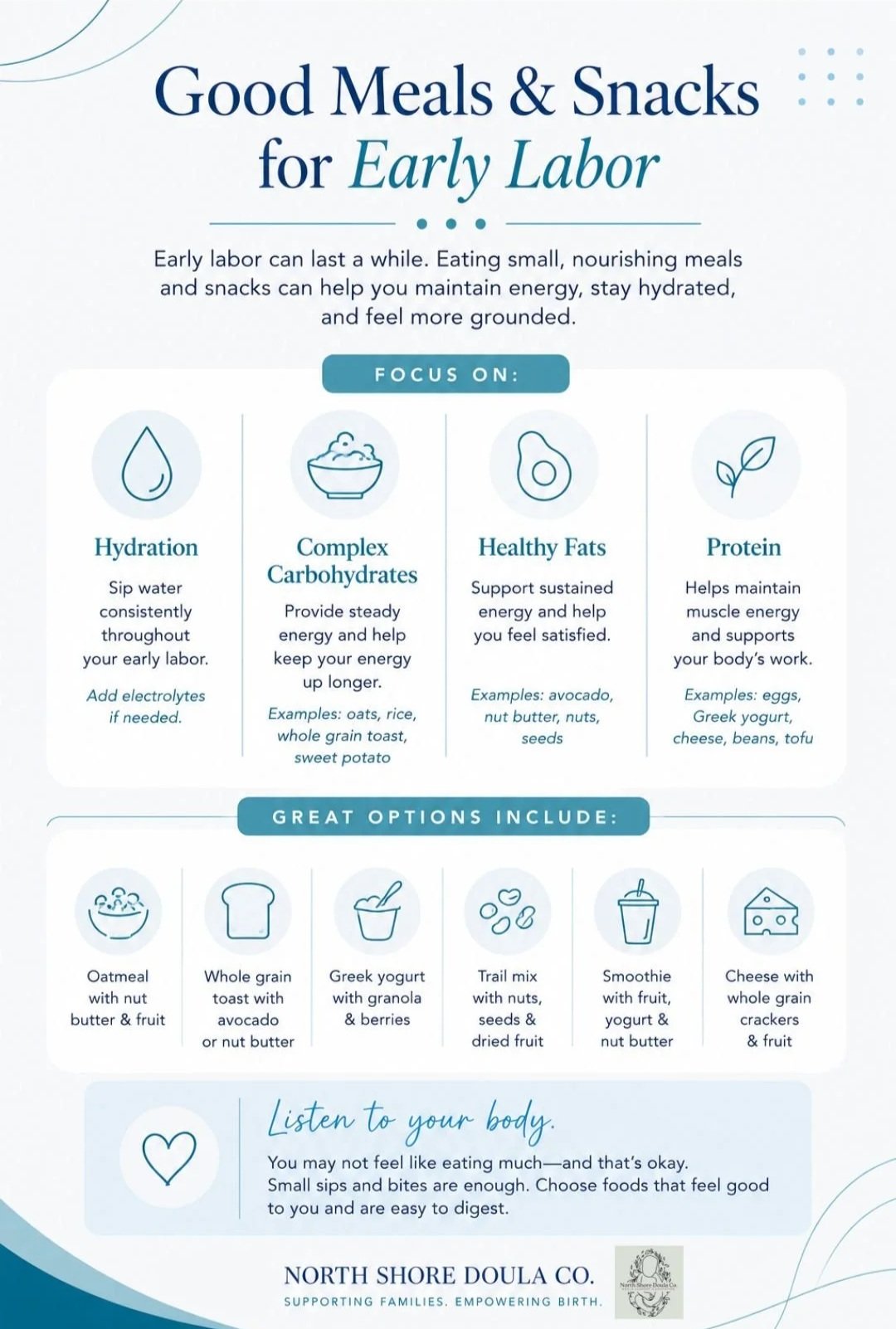
Another vital piece of sustainability during labor is hydration. Your uterus is a muscle, and just like if you were to run a marathon, hydration supports normal muscle function, including the uterus, throughout labor.
Early labor really is the time to fuel the body. Once you reach active labor you will likely have less desire to eat, and you may become nauseated. This is one reason many doulas encourage eating and drinking well during early labor whenever you feel able.
Stay comfortable
You will become progressively less able to get comfortable as labor continues to progress. Early labor is the time to really cultivate the oxytocin and seek comfort.
Think cozy. Dim the lights. Put on a favorite movie. Curl up with your favorite blanket. Laugh with your partner. Snuggle your pet. These little comforts help cultivate feelings of safety and connection, which support oxytocin release, encouraging labor progression.
The goal is to fill your cup as much as possible.
Families might:
Go for a leisurely walk
Take a relaxing shower or bath
Watch a cozy movie
Snuggle together
Listen to music
Read
Rest
Labor will progress. Now is not necessarily the time to access the contraction coping tool belt.
Early labor is mostly a game of distraction.

Stay home (when appropriate)
Home is an ideal place for you to get comfortable, and with early labor lasting anywhere between 8-24 hours, comfort is exactly what you need.
Heading to the hospital at the first sign of labor is an option. However, this can lead to a few outcomes. Arriving at the hospital very early in labor can sometimes increase the likelihood of interventions simply because you'll spend more time in the hospital while labor unfolds. You also might get sent home if the hospital cannot accommodate low risk patients in early labor. Neither of these occurrences are inherently “bad”, but they could throw a wrench in your plans or even slow your natural progression of labor.
For many low-risk pregnancies, home is often the most comfortable place to spend early labor, with your familiar lighting and smells and textures. Perhaps your favorite blanket or your pet can bring you comfort in your home. Because of this, your home is also a perfect place to boost your oxytocin! Cultivate feelings of safety, love and connection. This will really get your labor moving.
When Should You Call Your Doula?
Many people worry about calling their doula “too early.”
Here’s the good new:
Your doula would always rather hear from you early than after you’ve been wondering for hours if you’re really in labor. Even if it’s the middle of the night, we always welcome your call. Let us take the guess work out!
Reach out to your doula, you can:
Ask questions
Describe symptoms
Talk through timing
Gain reassurance
Discuss next steps
Your doula support often begins long before anyone comes to the house or hospital. When things shift, we want to hear from you.
When Should You Call Your Healthcare Provider?
Your doula is often the first person you'll want to check in with as labor begins. They can help you navigate when would be a good time to move to the next tier of support; calling your provider.
Your OB or midwife will likely give you some guidelines for when to call them about possible labor symptoms:
Water breaks, noting the timing of this is very helpful information
Contractions becoming more regular, longer, and stronger.
Vaginal bleeding, with labor, this can mean cervical change, but note the amount
Decreased fetal movement
Fever
Signs of dehydration
Concerns about baby’s well-being
It is important to follow your provider’s recommendations. But also listen to your doula. They can help you discern what is expected with labor, and what might need more medical support.

How Long Does Early Labor Last?
There is quite a wide range of how long early labor can last!
For first births, early labor may last many hours. For subsequent births, it may be considerably shorter.
8 hours is on the shorter side, and 24 hours to several days is on the longer side of typical early labor.
The length doesn’t predict whether labor is progressing “well.” Active labor is generally the phase where cervical change becomes more predictable.
Prodromal labor refers to contractions that start, stop, and start again over the course of several days without progressing into active labor. It can be exciting, then frustrating, then exhausting. But eventually the body usually falls into a predictable labor pattern.
Precipitous labor, when contractions start, and baby is born three hours later, is also a variation of normal. And to some, this may sound ideal. However that much change, that quickly can come with its own concerns.
Bodies simply work at different paces, and that’s okay. Your doula can help you navigate confusion, questions, and point you in the right direction.
A Gentle Reminder
Early labor can feel exciting, confusing, peaceful, frustrating, or all of those emotions in the span of a few hours.
It is productive, even when it feels slow.
Progress isn’t measured only in centimeters.
It’s measured in the unseen work your body is doing to prepare for birth.
You don’t need to rush.
You don’t need to wonder whether you’re doing enough.
Sometimes the most helpful thing you can do is trust your body, stay comfortable, and lean on the support you’ve chosen.

At North Shore Doula Co., we support families through every stage of labor, including those long, uncertain hours at the beginning when reassurance and encouragement can make all the difference.
Whether labor starts with a dramatic gush of fluid or a few mild contractions while you’re answering emails, you don’t have to navigate it alone.
-
Early labor often begins with mild to moderate contractions that gradually become longer, stronger, and more regular. You may also notice cramping, backache, bloody show, or the loss of your mucus plug. If you're unsure, check in with your doula. That's exactly what we’re here for!
-
Yes. While early labor often lasts 8 to 24 hours, it can occasionally last several days, especially if you're experiencing prodromal labor. Although it can be tiring, it doesn't necessarily mean anything is wrong.
-
For many people with uncomplicated pregnancies, early labor is most comfortably spent at home. Follow your healthcare provider's recommendations about when to come in, and let them know if you have heavy bleeding, decreased fetal movement, a fever, or any other urgent concerns.
-
Absolutely. If you're able to sleep or rest between contractions, take advantage of it. Early labor can be long, and conserving your energy now can help you later in labor.
-
Prodromal labor is a pattern of contractions that start, stop, and start again without progressing into active labor. Although it can be frustrating and exhausting, it is considered a normal variation of labor and doesn't necessarily mean anything is wrong.